What to Wear to Mediation: Dress Code and Attire Guide for Every Session
Learn what to wear to mediation by dispute type, format, and formality level. Practical attire guidance for clients and counsel in Canadian ADR sessions.
Mediation has no binding dress code, yet clothing choices carry real weight in a process built on credibility and good faith. For most Canadian mediation contexts, business casual is the minimum standard, business professional is appropriate for high-stakes matters, and attire should be calibrated to the dispute type, venue, and parties involved.
Why Your Appearance Matters in Mediation
Before you prepare your opening statement, consider this: how you dress to mediation sends a message before you say a single word. In a process where credibility, goodwill, and mutual respect shape outcomes, your clothing functions as a nonverbal signal. Dismissing attire as trivial can undermine the preparation a client or counsel has invested in the session itself.
Mediation is a voluntary, confidential ADR process used across Canada in employment, commercial, family, and construction disputes. Unlike court, mediation has no binding dress code, making deliberate choice more, not less, important. Social psychology research consistently links appearance to perceived competence and trustworthiness, with first impressions forming in roughly 7 seconds of meeting. Industry leaders such as JAMS have published specific guidance on professional attire for mediation, underscoring that this is a substantive preparation issue, not a superficial one.
Does what you wear to mediation actually affect the outcome?
The mediation process depends on negotiation and mutual agreement, not adjudication. No mediator decides a winner. However, social-perception research shows first impressions form within seconds and influence the tone of early exchanges. A client who arrives dressed thoughtfully signals cooperative intent from the outset; one who appears disengaged through dress can inadvertently set a defensive tone. The mediator, as a neutral facilitator, does not judge attire directly, but the other party and their counsel will notice. For a full explanation of the mediator's role, see What Is Mediation? Process, Roles, and Benefits in Canada.
How attire signals respect for the process and the mediator
Arriving well-dressed communicates that the client takes the process seriously. The mediator, as a neutral subject matter expert, reads the room; deliberate, professional presentation signals good-faith participation. Mediation is a formal legal service even when held outside a courthouse, and the parties, counsel, and neutral all operate within a structured professional framework. Treating the session with the same seriousness you would bring to a court-connected service reflects well on your intent and preparation.
The psychological role of professional appearance in a neutral setting
Research published in 2012 by Adam and Galinsky introduced the concept of "enclothed cognition": wearing clothes associated with professionalism can improve the wearer's own focus and confidence. In a neutral ADR setting, neither party holds a procedural advantage, making attire one of the few controllable signals available before the session begins. Dressing deliberately does not produce guaranteed outcomes, but it can support the wearer's own composure and signal a considered personal style that projects readiness. Choosing an outfit that matches the gravity of the dispute is a small, concrete act of preparation that costs nothing but pays dividends in how you carry yourself throughout the mediation session.
How Formal Should Mediation Attire Be?
If you received a notice to attend mediation tomorrow, would you reach for a business suit, smart casual separates, or something in between? The answer depends on several overlapping factors: the dispute type, the venue, the parties involved, and whether the session is in-person or virtual.
| Setting | Typical Formality Level | Dress Standard | Notes |
|---|---|---|---|
| Mediation | Moderate to high | Business casual minimum; business professional for high-stakes matters | No binding dress rule; deliberate choice matters |
| Superior Court | High | Business professional | Judge, public gallery, formal rules of evidence |
| Internal HR Meeting | Low to moderate | Smart casual | Internal setting, less formal, but still professional |
Mediation is generally less formal than Superior Court proceedings but more formal than an internal HR meeting. Business casual is the floor, not the ceiling, for most Canadian mediation contexts. A business or business-casual standard applies across the majority of Canadian mediation venues, with the formality level rising in proportion to the stakes involved.
Is mediation as formal as a court appearance?
Mediation is explicitly distinct from the litigation process: there is no judge, no public gallery, and no formal rules of evidence. Mediation under Canadian ADR frameworks is private and consensual. That said, some mediations are court-connected; for example, Ontario's mandatory mediation program under Rule 24.1 places sessions in close proximity to formal court proceedings, which raises attire expectations accordingly. For readers who want to understand where mediation sits relative to other formal proceedings, Arbitration vs Mediation: Key Differences in Dispute Resolution provides a clear comparison of each process in the Canadian context.
Business casual vs. business professional: which standard applies?
Business professional means a suit with a tie or equivalent; business casual means dress trousers or a skirt, a collared shirt, and an optional blazer. For most Canadian mediation contexts, business casual is the appropriate minimum. Business professional is warranted for high-stakes commercial or family law matters. Attorney representatives typically attend in professional attire, which sets a visual baseline the client should consider matching. Arriving in noticeably less formal attire than your own counsel can create an unintended impression of disengagement.
How the type of mediation affects the appropriate dress code
The dispute type should directly inform clothing choices. Family and divorce mediation may call for approachable professional dress that signals cooperation rather than dominance. Commercial mediation warrants business professional attire, consistent with the corporate context. Workplace mediation sits in the middle, closer to a senior interview than a boardroom presentation. A family mediation client, for instance, may wish to appear warm and cooperative; selecting softer tones and avoiding aggressive fashion choices supports that intention. For further context on mediation types in Canada, see Mediation Services in Canada: Process, Issues, and Choosing a Mediator.
In-person vs. virtual mediation: does the format change the attire rules?
Zoom mediation and other virtual formats became significantly more common after 2020 in Canada. Attire standards do not decrease for virtual sessions. The camera frames the upper body, so the focus shifts to the visible portion: top-half grooming, background, and lighting become the primary considerations. A structured blazer or collared shirt reads as professional on camera; a casual top does not, regardless of what is happening below the frame. JAMS guidance published on this topic confirms that virtual sessions warrant the same deliberate clothing choices as in-person ones. Prepare your background and lighting as carefully as your clothing, and avoid anything visually distracting that would pull attention away from the dialogue and the productive use of everyone's time.
What to Wear to Mediation: Practical Guidance by Category
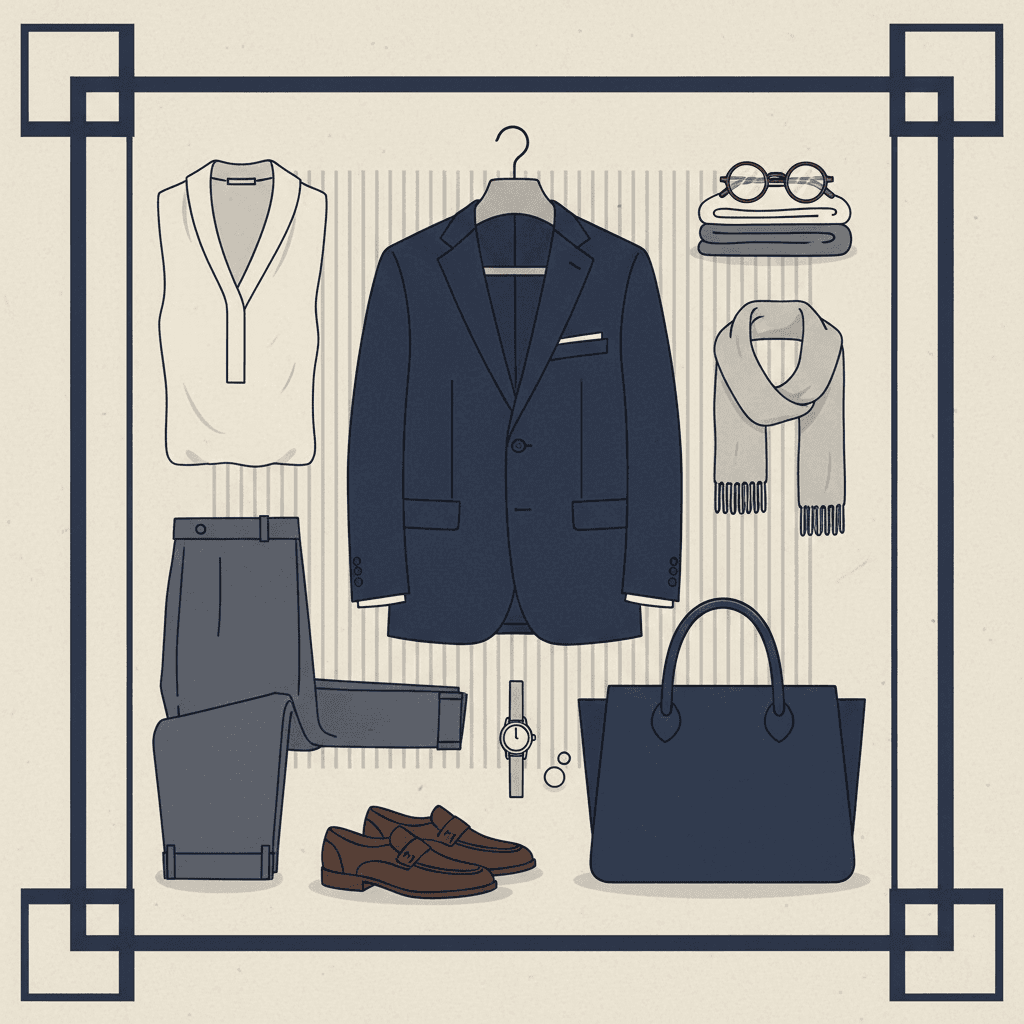
Think of selecting mediation attire the way you would select the tone of a written brief: deliberate, calibrated to the audience, and free of distractions that could shift attention away from your core message. A well-chosen outfit does the same work, keeping the focus on substance. For concrete examples of appropriate mediation clothing across different dispute types, practitioner-facing guides offer useful reference points. Neutral colours such as navy, grey, charcoal, black, white, and cream are consistently cited in ADR-adjacent style guides as credibility-supportive, with blue tones specifically associated with trustworthiness in colour psychology literature.
Recommended clothing options for mediation sessions
Use these options as a practical checklist for your next mediation session:
- Tops: Structured blouse, collared shirt, or fitted sweater in a neutral or muted tone
- Bottoms: Tailored trousers, dress trousers, chinos, or a knee-length or midi skirt
- Outerwear: Blazer or sport coat; adds formality to business-casual separates
- Footwear: Low-to-mid heel, flat dress shoe, or polished leather shoe; clean and unscuffed
- Grooming: Hair tidy, minimal fragrance, clean and pressed clothing
- Accessories: One watch, simple and understated jewellery; avoid anything noisy or distracting
- Optional tie: Appropriate for commercial matters or when matching counsel's attire level
Do you need to wear a suit to mediation?
This is a common question clients raise with counsel before a mediation session. A full suit is not required in most Canadian mediation contexts, but it is never inappropriate in a formal commercial or legal matter. A blazer over business-casual separates is often sufficient and provides flexibility across the range of formality levels you might encounter. The key is that your clothing should be clean, pressed, and intentional, whether or not it constitutes a full suit.
What colours and patterns work best for a professional mediation appearance
Neutral and muted tones are the safest choices: navy, grey, charcoal, cream, white, and soft blue. Colour psychology associates blue with trust and grey with neutrality, both useful signals in a collaborative ADR context. Fine stripes and subtle checks are acceptable patterns; bold graphics, slogans, or busy prints should be avoided. Loud or neon colours draw attention to fashion rather than substance, which is counterproductive in a setting where dialogue is the goal. Keeping your clothing visually quiet helps the mediator and opposing parties remain focused on the issues rather than your appearance.
Accessories, footwear, and grooming considerations
Keep accessories minimal: one watch and simple jewellery are sufficient. Footwear should be clean and polished; avoid casual options such as sneakers or sandals. Grooming should be clean, neat, and professional. Avoid heavy fragrances, as a closed mediation room can amplify scent and cause discomfort for other participants. Hair should be tidy. Prepare for a session that may run several hours; for context on session duration, see How Long Can Mediation Take in Canada?. Comfortable yet professional footwear is a practical consideration worth factoring into your preparation well before the day of the mediation session and the time you spend in the room.
What to Avoid Wearing to Mediation
According to JAMS, one of North America's largest ADR providers, clothing choices in mediation and arbitration sessions can shift the dynamics of a session before a single word is spoken. The gap between a credibility-supporting outfit and a credibility-undermining one is often narrower than clients expect, and the wrong choice is easier to avoid than most people realise. Casual or logo-bearing clothing is flagged in at least 3 practitioner-facing guides as inappropriate for mediation. Sessions in Canada can last anywhere from 3 to 8 hours, making comfort relevant but not a reason to dress casually.
Can you wear casual clothes like jeans or athleisure to mediation?
Jeans and athleisure are not appropriate for mediation sessions, even informal ones. Dark, well-fitted jeans paired with a structured blazer and dress footwear occupy borderline territory, but the safer choice is always dress trousers or a skirt. Athleisure, including leggings, joggers, and athletic shoes, signals disengagement from the seriousness of the process. When in doubt, a client should err toward more formal clothing rather than less; it is far easier to remove a blazer than to recover from an appearance that reads as dismissive.
Clothing choices that may undermine credibility or distract from the process
Avoid bringing the following to your child custody, commercial, or workplace mediation:
- Graphic T-shirts or slogan clothing that communicates a viewpoint or affiliation
- Heavily branded or logo-covered items that draw the eye away from dialogue
- Revealing or overly casual tops that are inconsistent with a professional legal service setting
- Flip-flops, athletic sneakers, or visibly worn footwear
- Wrinkled, visibly unwashed, or poorly fitted clothing
- Extremely bright colours or busy patterns that distract the mediator and opposing parties
- Heavy jewellery that creates noise or physical distraction during extended sessions
Each of these choices shifts energy away from productive dialogue and toward unnecessary distraction. The neutral mediator, focused on process facilitation, works best when the room's attention is on the issues at hand.
Mediation Attire Across Different Dispute Types in Canada
Alternative dispute resolution in Canada expanded significantly after the late 1990s, when Ontario introduced mandatory mediation for certain civil matters. Ontario's mandatory mediation program under Rule 24.1 was introduced in 1999, and today mediation is used to resolve employment grievances, commercial contract disputes, construction disagreements, and family law matters. Each context carries its own professional norms and attire expectations that a well-prepared client should understand before walking in the door.
Employment and workplace mediation dress expectations
Workplace mediation often involves employees, managers, HR representatives, and sometimes union representatives or an attorney in the same room. The employee-party should dress at least as formally as they would for a senior job interview, with business casual as the minimum standard. If represented by counsel, the client should aim to match that attire level. For background on what workplace mediation involves procedurally, see What Is Mediation? Process, Roles, and Benefits in Canada. Employment disputes are among the most common ADR matters in Canada, and the formality of the mediation room reflects the legal weight of the outcome.
Commercial and construction dispute mediation
Commercial and construction mediations typically involve corporate representatives, legal counsel, and expert witnesses. Business professional attire is the standard across these contexts. Construction disputes may involve site managers or engineers who are less accustomed to formal dress in their day-to-day roles, but the recommendation remains business professional for the mediation room regardless. Construction matters rank among the top 3 commercial dispute categories in Canadian ADR caseloads. The business woman or corporate executive attending a commercial mediation should apply the same attire standard they would bring to a formal client presentation or court-connected proceeding.
Family mediation: balancing professionalism with approachability
Family and divorce mediation carries a distinct emotional register. Parties are often working to reduce tension rather than litigate a dispute, and the mediator may be actively managing the relational dynamics in the room. Attire should be professional but not intimidating: a blazer over a soft-toned shirt or blouse strikes a better balance than a full power suit. Avoid choices that signal dominance or aggression in appearance. Family mediation often addresses parenting arrangements and asset division, and the client's presentation should signal cooperative intent. Sessions in Canada commonly last between 2 and 4 hours per sitting, so wear clothing that is both polished and comfortable enough to sustain focus throughout.
Key Takeaways
- Business casual is the minimum standard for Canadian mediation; business professional is appropriate for commercial, construction, and high-stakes family matters
- Match your attire to the formality level set by your own counsel; arriving less formally dressed than your legal representative sends an unintended signal
- Virtual mediation requires the same deliberate clothing choices as in-person sessions; the camera frames your upper body, so prioritise your top half and grooming
- Neutral colours such as navy, grey, and soft blue support credibility; avoid loud prints, slogans, heavy logos, and casual footwear
- Prepare your outfit in advance as part of your overall session preparation, alongside your documents and key points, not as an afterthought on the morning of the mediation session
FAQ
What is the general dress code for mediation in Canada?
There is no legally binding dress code for mediation in Canada, but business casual is the widely accepted minimum standard. Business professional attire is appropriate for commercial, construction, and formal family law matters. The absence of a formal rule makes deliberate choice more important:
- Business casual minimum: dress trousers or skirt, collared shirt, optional blazer
- Business professional for high-stakes matters: full suit or equivalent
- Virtual sessions: same standards apply to your visible upper half
Can I wear jeans to a mediation session?
Jeans are generally not recommended. Dark, well-fitted jeans paired with a structured blazer and polished footwear occupy borderline territory, but dress trousers or a skirt are the safer and more professional choice. Athleisure, including joggers and athletic sneakers, is not appropriate under any circumstances. The mediator will not rule on your attire, but the other parties and their counsel will form an impression.
Does virtual mediation require the same level of dress as in-person?
Yes. Virtual sessions require the same deliberate clothing choices as in-person ones. The camera frames your upper body, so a structured blazer, collared shirt, or professional blouse is essential. Your background and lighting also contribute to your overall professional presentation. Dressing casually for a Zoom mediation can undermine the credibility you have worked to build through your preparation and documentation.
What should I wear to a family or divorce mediation?
For child custody or divorce mediation, choose professional but approachable attire: a blazer over a soft-toned blouse or shirt, dress trousers or a midi skirt, and clean polished footwear. Avoid aggressive power-dressing or anything that signals dominance. The goal is to present as cooperative and engaged. Neutral tones such as navy, grey, or cream support that impression without being distracting.
Should I match my attorney's level of dress at mediation?
Using your attorney's attire as a baseline is a practical guideline. If your counsel arrives in a business suit and you arrive in jeans, the visual contrast can inadvertently signal that you take the matter less seriously. Arriving at the same or a slightly less formal level than counsel is appropriate; arriving noticeably less formally is a choice worth reconsidering before the mediation process unfolds.